Ground Realities Of Israel, USA, Iran War
March 8, 2026
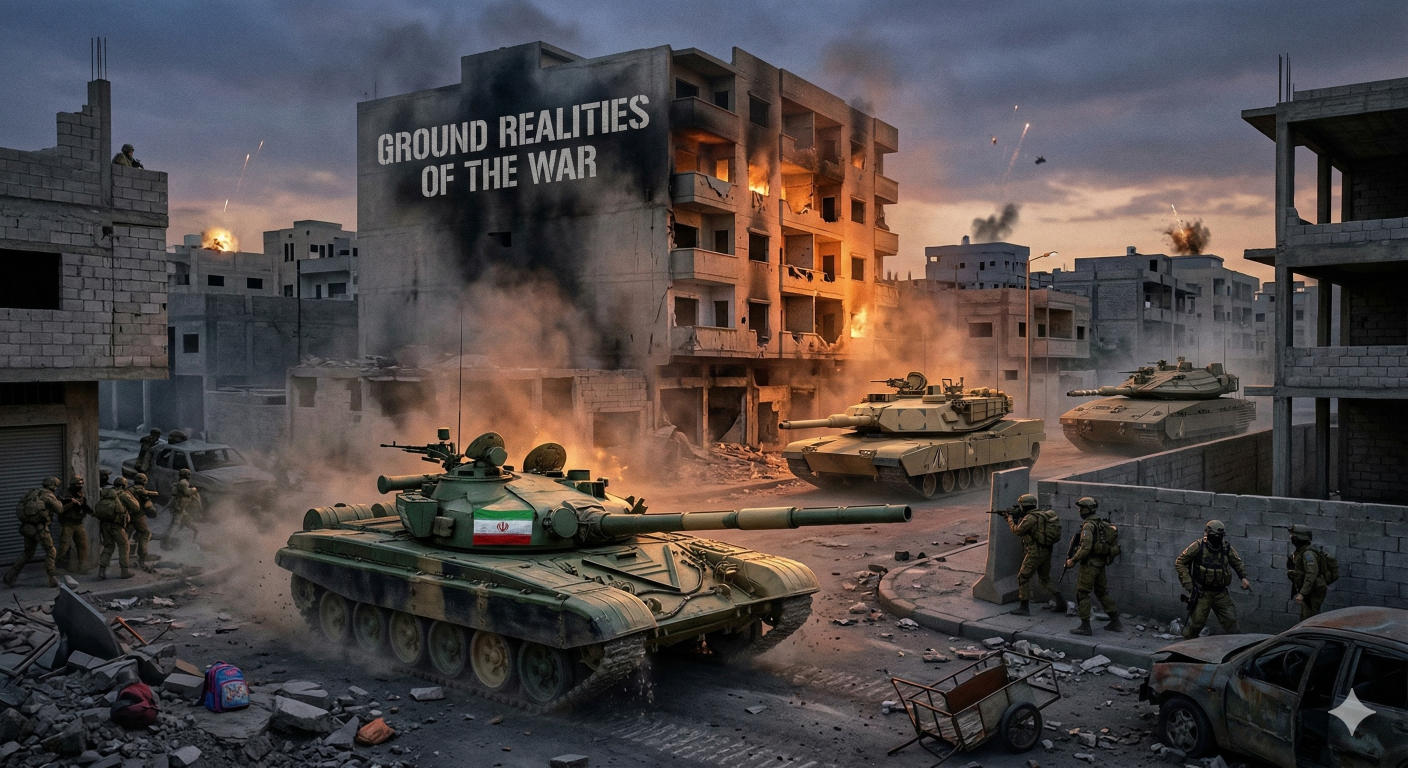
This is the most significant and rapidly evolving military conflict in the world today.
1. On February 28, 2026, the United States and Israel launched coordinated air strikes against Iran, beginning a war primarily aimed at destroying Iran's missile programme. What followed has rapidly escalated into the most intense American air campaign in decades, drawing in multiple nations across the Middle East.
2. The war began with joint strikes against military and government sites in Tehran, Isfahan, Qom, Karaj, and Kermanshah. Among the most consequential early developments: strikes killed Iranian Supreme Leader Ayatollah Ali Khamenei along with dozens of his top officials.
3. As of March 8, 2026 — Day 9 of the conflict — the Iranian Red Crescent has reported over 1,332 killed inside Iran. US Central Command confirmed more than 3,000 strikes inside Iranian territory. Six US soldiers have been killed so far. Research group Airwars described the initial assault as hitting "significantly more targets per day than any campaign in recent decades" — surpassing both Israel's war on Gaza and the US-led campaign against ISIS in Iraq and Syria in 2014.
How the conflict spread across the region
Iran has not fought alone. The Islamic Revolutionary Guard Corps says it has launched attacks on at least 27 bases across the Middle East where US troops are deployed, as well as Israeli military facilities in Tel Aviv and other parts of Israel. The strikes have rippled across the Gulf. Saudi Arabia, Qatar, Bahrain, and the UAE saw drone and missile attacks, with blasts reported in Abu Dhabi and Qatar. Dubai's international airport came under drone attack multiple times. Saudi Arabia's Defence Ministry said 16 drones heading toward the Shaybah oil field — one of the largest in the world — were intercepted.
Jordan's armed forces reported intercepting 49 drones and ballistic missiles in Jordanian airspace. Kuwait confirmed several US warplanes crashed on its territory, with at least three civilians killed. Lebanon has also been drawn in, with Hezbollah launching attacks on Israel and Israeli forces striking across southern and eastern Lebanon, killing nearly 300 people according to Lebanon's Health Ministry. What each side wants US President Donald Trump has made his position clear: any deal with Iran must result in the country's "unconditional surrender." The strikes followed the collapse of indirect nuclear talks in early February 2026, where the US demanded Iran end all uranium enrichment entirely. Iran shows no sign of backing down. Iran's top security official Ali Larijani vowed that the US president "must pay the price."
President Masoud Pezeshkian, while apologising to Gulf neighbours for civilian harm, insisted Iran would never surrender. The White House has suggested the campaign may last four to six weeks. What comes after — to Iran's leadership, its nuclear programme, and the region's balance of power — remains deeply uncertain. Energy markets under threat Iran has confirmed the Strait of Hormuz remains open but has threatened to target any US or Israeli ships attempting passage. It has also threatened to strike oil refineries in northern Israel. A major disruption to Hormuz — through which roughly 20% of the world's oil flows — would send immediate shockwaves through the global economy.
The UN Secretary-General António Guterres condemned the strikes as "squandering" an opportunity for diplomacy. The UN Security Council met in emergency session but passed no resolution.
Link to Next Article: Click here to read the next article
Keywords: global politics 2026, world economy 2026, Iran Israel USA war, US China trade war, Russia Ukraine 2026, geopolitical risk, global economic outlook, world news March 2026, international relations, trade tariffs 2026