What is new technology in 2026
March 11, 2026
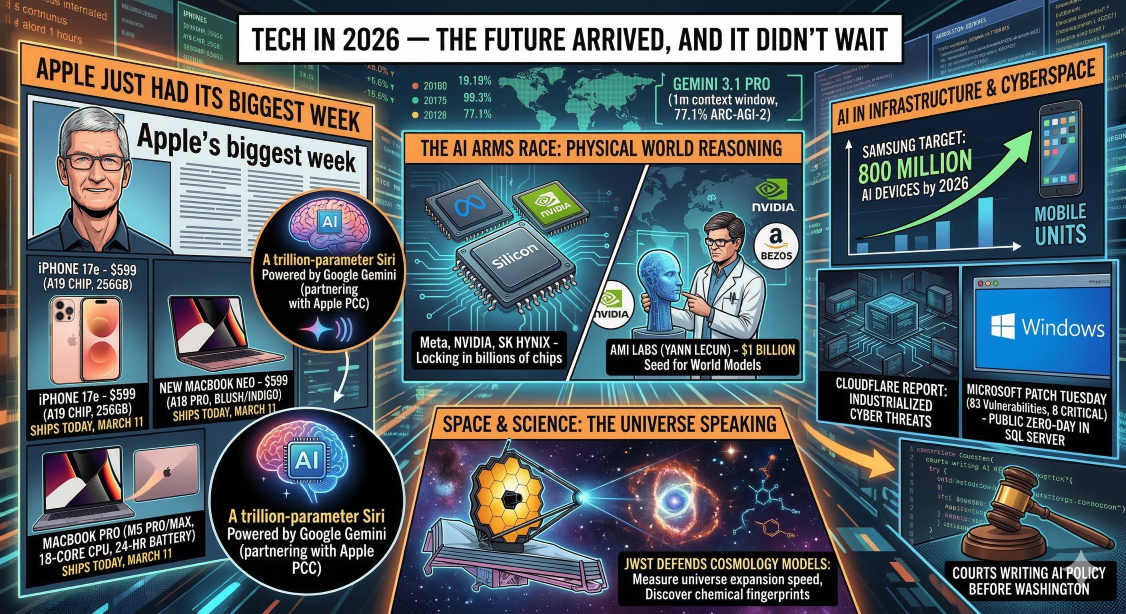
💻 Tech in 2026 — The Future Arrived, And It Didn’t Wait For Anyone
March 11, 2026 | AI, Apple, Cybersecurity, Space & The Race That Never Stops
In a lab somewhere, a machine learns something it wasn’t explicitly taught. In a boardroom, a billion-dollar bet is placed on a technology that barely existed three years ago. And in your pocket, a device that just launched today is already being called obsolete by the one in development behind closed doors.
Welcome to the technology world in March 2026. Blink and you’ll miss three announcements.
Chapter 1: Apple Just Had Its Biggest Week in Years — And Everything Ships Today
It started with a tease. Apple CEO Tim Cook posted two words — “Big week ahead” — and the internet did what it always does: lost its mind.
He wasn’t wrong.
Over three consecutive days last week, Apple unleashed a product lineup that left analysts scrambling for superlatives. The announcements included the iPhone 17e, iPad Air with the M4 chip, MacBook Air with M5, MacBook Pro with M5 Pro and M5 Max, and a brand-new MacBook Neo entry-level laptop — plus a refreshed Studio Display and Studio Display XDR.
But the real story? The MacBook Neo.
Apple’s new MacBook Neo starts at just $599, runs on an A18 Pro processor, sports a 13-inch screen, and comes in four colors: blush, indigo, silver, and citrus. For years, the MacBook was Apple’s premium fortress — the device that cost more than most people’s rent. The Neo tears that wall down. It’s already being called the most important Apple product of 2026.
The iPhone 17e also launched today at $599, powered by the same A19 chip found in the base iPhone 17. It gains MagSafe, doubles its base storage to 256GB, and arrives in a new soft pink colorway. Not the flashiest iPhone Apple’s ever made — but arguably the smartest value play in its lineup.
The new MacBook Pro models with M5 Pro and M5 Max now pack an 18-core CPU and up to 24 hours of battery life — the longest ever recorded in a Mac.
Everything ships today. March 11. Go.
Chapter 2: The AI Arms Race Has a New Battlefield — And It’s Inside Your Head
The artificial intelligence story of 2026 isn’t just about chatbots anymore. It’s about infrastructure, power, and who controls the hardware that runs the world’s intelligence.
Meta is locking in millions of Nvidia chips. SK Hynix is ramping AI memory output. The industry’s biggest players are moving aggressively to secure the hardware backbone of the intelligence economy. This isn’t a software war. It’s a supply chain war. And Nvidia, quietly, is winning it.
Meanwhile, former Meta AI chief Yann LeCun’s new company AMI Labs has raised more than $1 billion — described as Europe’s largest seed round — to pursue “world models,” an approach that builds AI systems learning from physical reality rather than next-token prediction. Backers include Nvidia, Temasek, and Jeff Bezos-linked capital. The bet: that the current generation of AI has a ceiling, and that whoever cracks physical-world reasoning first wins everything.
On the model front, Google DeepMind’s Gemini 3.1 Pro now features a 1-million-token context window and scored 77.1% on ARC-AGI-2 — a benchmark designed to be genuinely hard for AI systems. Meanwhile, Apple is rolling out a reimagined AI-powered Siri alongside iOS 26.4 — partnering with Google to use its 1.2 trillion parameter Gemini model, running on Apple’s Private Cloud Compute to maintain privacy standards. The two biggest consumer tech rivals in history are quietly sharing a brain.
And Siri — for so long the butt of every AI joke — might finally be worth taking seriously.
Chapter 3: Siri Gets a Brain, Samsung Gets Ambitious
Samsung has announced an ambitious goal: to double the number of its mobile devices equipped with Google’s Gemini AI, targeting 800 million units by the end of 2026. Eight hundred million. That’s not a product strategy. That’s a civilization-scale deployment.
The devices that carry AI aren’t just getting smarter — they’re becoming infrastructure. The line between a phone and a personal assistant is dissolving. The line between a laptop and a co-worker is not far behind.
Chapter 4: The Cyber Threat Is Getting Industrial
Not all of tech’s 2026 story is about gleaming new products and glossy keynotes.
Cloudflare’s latest threat report describes what it calls “the total industrialization of cyber threats” — hackers weaponizing the internet itself. The report describes automated attack pipelines so efficient and so scalable that the concept of a lone hacker in a dark room is essentially fiction now. Cybercrime has become a supply chain.
Microsoft’s March 2026 Patch Tuesday addressed 83 vulnerabilities across Windows — eight rated critical, 75 rated important. Among the most serious: elevation-of-privilege flaws that could hand attackers full SYSTEM access, and a publicly disclosed zero-day in SQL Server. If you’re on Windows, update now. Seriously.
Courts are now emerging as a new battleground for AI accountability — with judges potentially setting standards for foreseeable harm, duty of care, and model testing long before Washington delivers comprehensive legislation. AI policy, it turns out, may be written by lawyers before it’s written by lawmakers.
Chapter 5: Space, Science & The Universe Speaking
While the earth churns with politics and product launches, the universe keeps doing what it does — being mind-bendingly large and strange.
NASA’s James Webb Space Telescope has revealed new clues about a mysterious cosmic explosion that defies existing models. In the same week, a rare gravitationally lensed supernova has given astronomers a new tool to measure how fast the universe is actually expanding — one of the longest-standing unsolved questions in cosmology.
Also: an international team used the James Webb telescope to discover chemical fingerprints in deep space that could reshape our understanding of how stars form and die. The most expensive telescope humanity ever built continues to earn every penny.
Chapter 6: What’s Coming — Events That Could Shape The Next Era
The tech calendar doesn’t slow down. Here’s what’s ahead:
🗓 TechCrunch Founder Summit 2026 — Coming soon, with 1,000+ founders and investors gathering to back the next generation of companies. Register before March 13 to save up to $300.
🗓 Google I/O 2026 — Expected in May. With Gemini 3.1 already out in the wild, all eyes will be on what Google announces next for AI, Android, and its developer ecosystem.
🗓 WWDC 2026 — Apple’s Worldwide Developers Conference is expected in June, where the next major versions of iOS, macOS, and — crucially — Apple Intelligence will be unveiled. With the new AI-powered Siri already rolling out, expect WWDC to go deeper.
🗓 MacBook Ultra — Mark Gurman reports Apple is planning an all-new “MacBook Ultra” later in 2026, featuring an OLED display, touchscreen capability, and a significantly higher price point. The MacBook Pro you’d buy today could look quaint by December.
Epilogue: The Machine Keeps Moving
Here is the honest truth about technology in March 2026: the pace has never been faster, the stakes have never been higher, and the gap between what’s possible and what exists is closing at a rate that makes even optimists nervous.
AI is moving from tool to infrastructure. Devices are moving from products to platforms. And the companies building this future are moving with a hunger that doesn’t take weekends off.
The future didn’t announce itself with a press release. It just showed up — in a $599 laptop, in a trillion-parameter model, in a telescope pointed at an exploding star four billion light years away.
It’s already here. The only question is whether you’re keeping up.
📌 More tech updates tomorrow. The story never stops — neither do we.