Oil Above $110 and Climbing : Prepare Yourself for the Worse
March 9, 2026
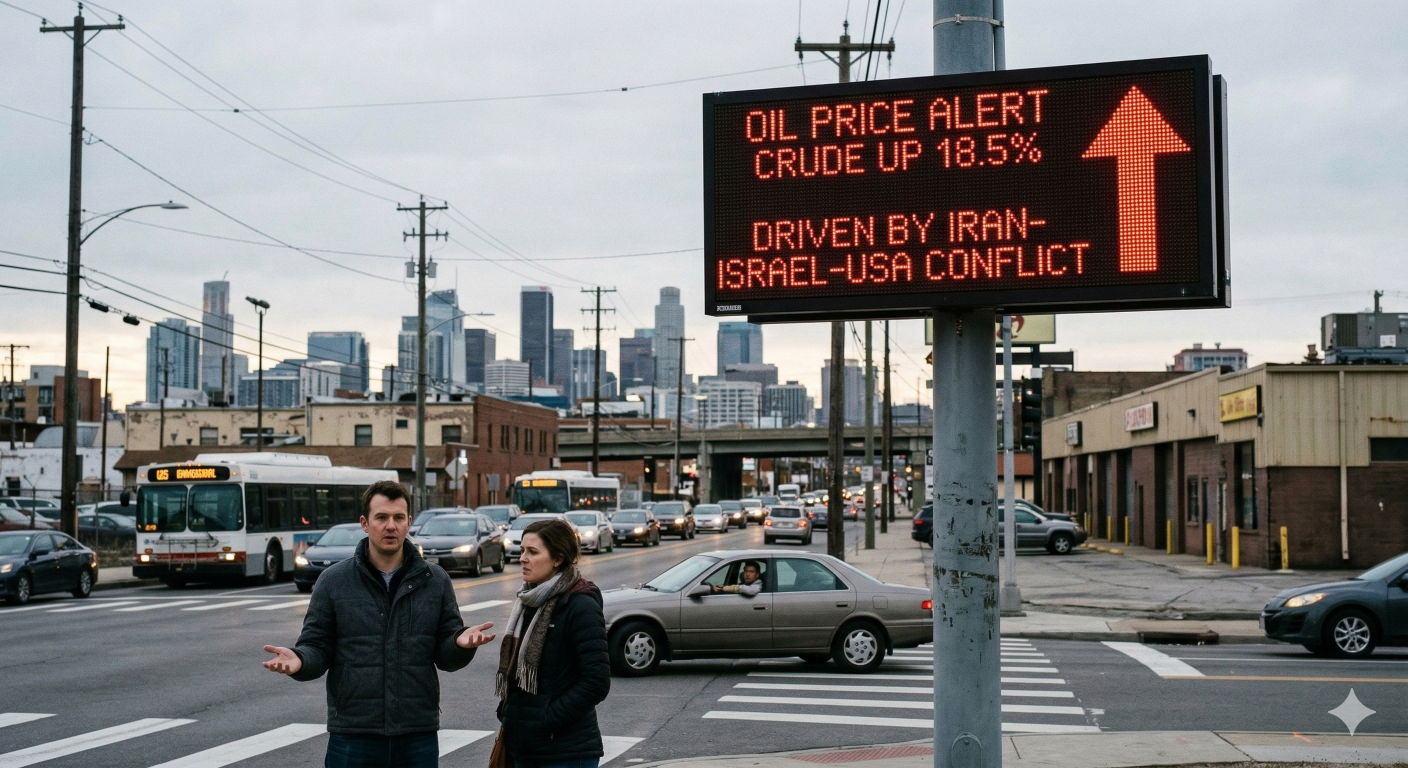
🔥 BREAKING: ENERGY CRISIS
Oil Above $110 and Climbing:
How the Strait of Hormuz Crisis Could Send Prices to $200 — and What It Means for You
March 9, 2026 | Global Energy & Markets | Est. read time: 7 minutes
Target Keywords: [SEO Keyword: oil prices today 2026] [SEO Keyword: Strait of Hormuz crisis] [SEO Keyword: Iran war oil prices] [SEO Keyword: crude oil price forecast 2026] [SEO Keyword: global energy crisis] [SEO Keyword: WTI Brent crude oil] [SEO Keyword: gas prices rising 2026] [SEO Keyword: OPEC oil market]
Just weeks ago, analysts were predicting oil would average $58 a barrel in 2026. Today, crude is trading above $110 — and some experts warn it could hit $200. Here's everything you need to know about the most dramatic oil crisis since the 1970s, and why it matters to every person on the planet.
"We're now facing what looks like the biggest energy crisis since the oil embargo in the 1970s." — Helima Croft, RBC Capital Markets
📊 Where Oil Prices Stand Right Now — March 9, 2026
Brent Crude/bbl
Peaked above $119 on Mar 8
WTI (US Crude)
+35.6% in one week — historic
Weekly Gain
Biggest since futures began in 1983
The Nightmare That Energy Markets Always Feared Has Arrived
For decades, energy analysts ran simulations of one terrifying scenario: a closure of the Strait of Hormuz. On February 28, 2026, that nightmare became reality.
Following joint U.S.-Israeli military strikes on Iran — including the killing of Supreme Leader Ali Khamenei — Iran's Revolutionary Guard Corps (IRGC) declared the 21-mile-wide strait effectively closed. Within 24 hours, tanker traffic dropped by over 70%. Within days, it was near zero.
The stakes are staggering. The strait channels roughly 20 million barrels of oil per day — about 20% of all global oil trade. There is no adequate alternative for most of this oil. Saudi Arabia and the UAE have bypass pipelines, but these can handle only an estimated 2.6 million barrels per day — a fraction of normal flows.
"When analysts have looked at the things that could go wrong in global oil markets, this is about as wrong as things could go at any single point of failure," said Kevin Book, co-founder of Clearview Energy Partners.
How Did We Get Here? A Rapid Timeline
To understand how oil prices exploded, it helps to trace the sequence of events over the past 10 days:
1. Feb 28: U.S. and Israel launch joint airstrikes on Iran, including a refinery near Tehran. Iranian Supreme Leader Khamenei is killed.
2. Mar 1–2: IRGC officially closes the Strait of Hormuz. Tanker traffic collapses. At least five vessels are struck by drones or missiles.
3. Mar 3: Qatar halts LNG production after strikes hit its Ras Laffan facility. European gas futures jump 30%.
4. Mar 6: WTI surges 35.63% for the week — the largest single-week gain in futures trading history dating back to 1983.
5. Mar 8–9: Brent briefly tops $119/bbl. Dow futures plunge over 1,000 points. Qatar's energy minister warns prices could hit $150.
6. Mar 9: Saudi Arabia reports releasing some reserves; markets moderate slightly. Prices remain above $110.
Why Cheap Drones Did What Navies Could Not
Here's the part that has military strategists reeling: Iran didn't need warships, underwater mines, or anti-ship missiles to achieve what many considered militarily impossible.
"All Iran had to do was several drone strikes in the vicinity of the Strait of Hormuz," explained Helima Croft of RBC Capital Markets. "And all of a sudden, insurers and shipping companies decided that it was unsafe to traverse that very narrow S-curve of that waterway."
Insurance withdrawal — not a physical blockade — is what stopped the oil. With no insurer willing to cover tankers in a war zone, even ships that could physically transit chose not to. Over 150 vessels are now anchored outside the strait, unable to move. Iraq has been forced to shut down production in some of its largest oil fields because it has nowhere to export the oil.
"The Strait of Hormuz is facing the biggest disruption in oil production in history." — Daniel Yergin, Energy Historian & Author
Who Gets Hit the Hardest? A Country-by-Country Breakdown
🇯🇵 Japan & South Korea — Extreme Vulnerability
Japan sources about 95% of its crude from Saudi Arabia, Kuwait, the UAE, and Qatar — roughly 70% of which travels through Hormuz. Japan's Nikkei 225 fell over 5% on March 9. South Korea's KOSPI plunged 8% intraday. Both countries hold only 3–4 weeks of LNG reserves.
🇮🇳 India — Acute Near-Term Pressure
About 60% of India's oil imports come from the Middle East. Qatar and the UAE account for 53% of India's LNG imports. India has activated emergency contingency plans but faces severe procurement constraints. Analysts at Nomura flag India as among the most vulnerable in Asia.
🇨🇳 China — Exposed but Buffered
China is the world's largest crude importer and holds roughly one billion barrels in strategic reserves — about half its total storage capacity. While around 40% of its oil imports pass through Hormuz, China's sheer scale and stockpiles give it more flexibility. It will likely pivot toward Russian crude if the crisis persists.
🇵🇰 Pakistan & Bangladesh — Critical LNG Risk
Qatar and the UAE supply 99% of Pakistan's LNG and 72% of Bangladesh's. With limited storage and a pre-existing gas deficit of over 1,300 million cubic feet per day in Bangladesh, these countries face potential energy rationing within weeks if the disruption persists.
🇺🇸 United States — Indirect But Real
The U.S. is energy-independent on paper, but oil is a global commodity. Gas prices are already expected to top $4 per gallon. The Dow Jones futures fell over 1,000 points. The Federal Reserve faces a nightmare scenario: inflation reignited by energy costs at a time when it was hoping for rate cuts.
The $150–$200 Scenario: Is It Really Possible?
Qatar's Energy Minister Saad al-Kaabi delivered the most alarming warning of the crisis: if tankers cannot pass through the strait, oil prices could reach $150 per barrel in the coming weeks — and the resulting shock could "bring down the economies of the world."
Iran's IRGC has gone further, threatening that if U.S.-Israeli strikes continue, oil could soar to $200 per barrel. Energy analysts at Discoveryalert note that sustained closure scenarios could push prices even higher during storage saturation phases, potentially triggering trading halts and emergency international measures.
The IMF has estimated that every sustained 10% rise in oil prices results in a 0.4% rise in global inflation and a 0.15% reduction in global economic growth. At $150/barrel — roughly a 65% rise from pre-crisis levels — the macroeconomic consequences would be severe.
"Current oil prices in the $90s are far from the worst-case scenario." — Daniel Yergin, writing before prices crossed $110
What would $150 oil actually mean in practice? Analysts at Morgan Stanley and JPMorgan estimate: airline tickets up 30–40%, food prices rising due to fertilizer and transport costs (one-third of global fertilizer trade also transits Hormuz), and central banks globally being forced into emergency policy pivots.
What Could Bring Prices Back Down?
Despite the panic, there are reasons for cautious optimism — if certain conditions are met:
• Diplomatic breakthrough: The G7 finance ministers are discussing coordinated strategic petroleum reserve releases. The IEA has the capacity to release substantial volumes.
• Saudi Arabia bypass pipeline: Saudi Aramco's East-West pipeline can route some crude to Red Sea ports. Reports on March 9 of Saudi reserve releases briefly calmed markets.
• U.S. Navy escorts: The U.S. has announced a $20 billion tanker reinsurance program and offered naval escorts — though experts are skeptical this will restore traffic quickly.
• Rapid ceasefire: U.S. Secretary of Energy Chris Wright insists any price rise will be "temporary." If a ceasefire materializes, the pre-crisis supply surplus could reassert itself quickly.
Before this crisis, the energy market outlook was bearish. The EIA forecast Brent averaging just $58/barrel in 2026 due to strong supply growth and a global surplus of 2–4 million barrels per day. That fundamental picture hasn't disappeared — it's just been buried under a geopolitical avalanche.
What Should You Do? Practical Implications
For Consumers
Fill up your tank sooner rather than later. Gas prices are tracking crude oil with a lag of several weeks. GasBuddy's Patrick De Haan puts the odds of $4+ U.S. gas at 80% within the next month. If you heat with oil or LNG, consider locking in prices now if possible.
For Investors
Energy stocks — particularly U.S. shale producers, pipeline operators, and LNG exporters — stand to benefit from elevated prices. However, the broader market correction (S&P 500 futures down 2% as of writing) reflects serious recession fears. Gold typically performs well during geopolitical crises; on March 8, it surpassed $5,000/oz before dipping. Diversification is key.
For Businesses
Supply chains are under severe stress. Industries reliant on petrochemical feedstocks, logistics, and international shipping face compounding pressures. Companies should activate contingency procurement strategies and hedge fuel costs where possible.
The Bottom Line
The global energy system has just suffered what analysts once described as the worst-case scenario at the world's most critical chokepoint. Oil above $100 is not a blip — it is the market pricing in a genuine supply emergency involving roughly one-fifth of global oil flows.
Whether this becomes a 1970s-style decade-long crisis or a short, sharp shock that fades with diplomacy depends on decisions being made in Washington, Tehran, Jerusalem, and Riyadh in the coming days. Markets will remain on edge until there is clarity.
One thing is certain: the era of cheap, predictable energy that defined the 2020s is, at least for now, over.
Sources & Further Reading
U.S. Energy Information Administration (EIA) Short-Term Energy Outlook — February 2026 | IEA Oil Market Report — February 2026 | J.P. Morgan Global Research — Oil Price Forecast 2026 | CNBC, Fortune, Al Jazeera, TIME, NPR — March 2026 news coverage | Wikipedia: 2026 Strait of Hormuz Crisis | Kpler Market Intelligence
Article compiled March 9, 2026. For the most current prices, check live oil market feeds.
Link to Next Articles: