AI (Artificial Intelligence) is Taking over everything
March 10, 2026
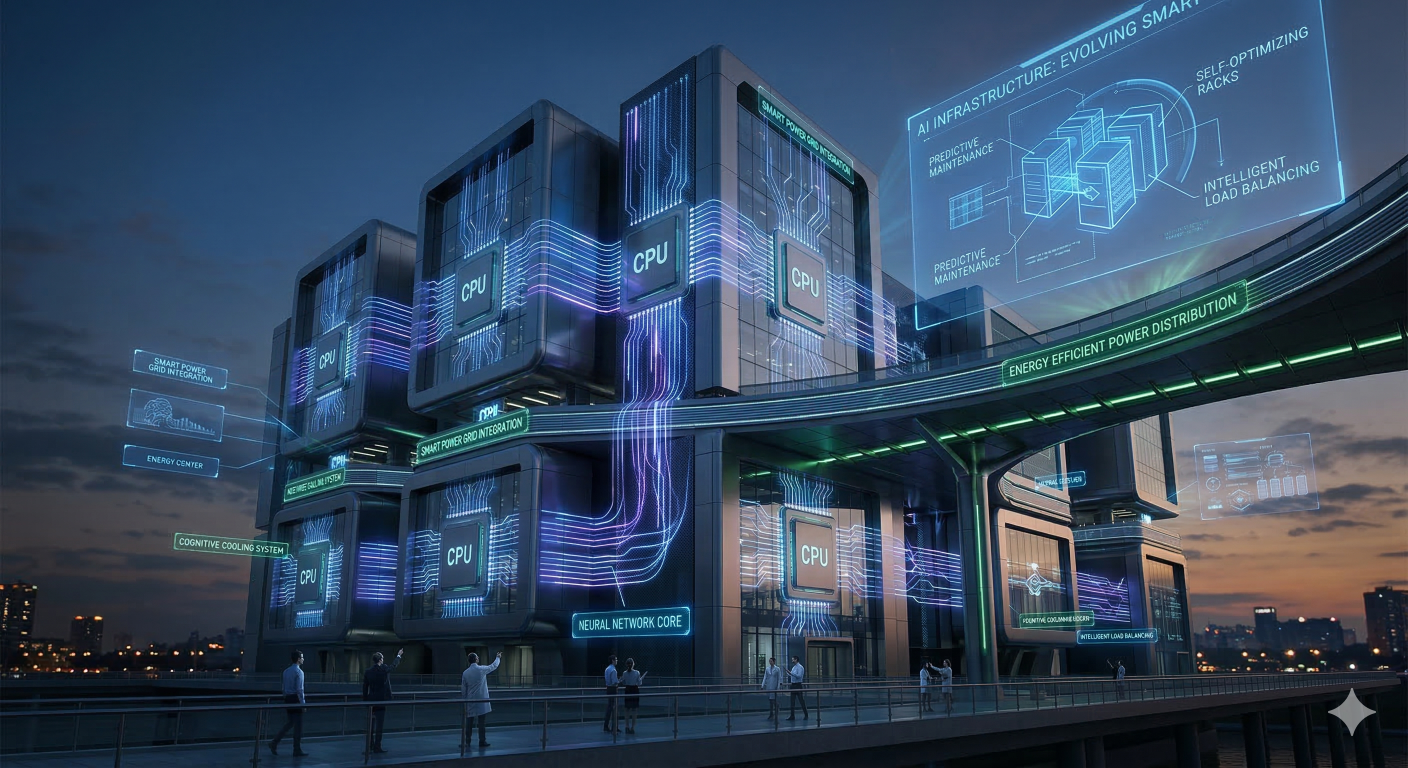
TECHNOLOGY & ENTERPRISE AI
The Silicon Bottleneck:
Why AI Infrastructure Is Finally Getting Smart
From copper wires to photons, from GPU shortages to power grids — the race to build the physical backbone of artificial intelligence is entering a smarter, more strategic
phase
March 10, 2026 | Technology Desk
For the past three years, the AI industry has operated with a single-minded obsession: get more chips, build more data centers, and worry about everything else later. That era is ending. As AI infrastructure spending races toward an extraordinary $600 billion in 2026, the smartest players in the industry are realizing that raw silicon was never really the whole story — and that the true bottleneck has been hiding in plain sight.
The constraints are shifting. The problems are getting harder. And the solutions, finally, are getting smarter.
The $600 Billion Infrastructure Supercycle
The sheer scale of what is being built right now is almost incomprehensible. The Big Five hyperscalers — Amazon, Microsoft, Google, Meta, and Oracle — are on track to collectively spend over $602 billion on AI infrastructure in 2026, with roughly 75% of that going directly toward AI-specific hardware and data centers. Capital intensity has hit 45–57% of revenue for these companies, forcing over $108 billion in debt issuance in 2025 alone, with projected sector-wide debt approaching $1.5 trillion over the coming years.
This is not a bubble — or at least, not yet. It is, as one analyst put it, 'the construction of the foundation for the next decade of global economic growth.' The AI infrastructure complex — comprising chipmakers, data center operators, cooling specialists, networking providers, and energy companies — is operating in a category of its own, even as traditional sectors face macro headwinds.
But within this gold rush, a critical maturity is setting in. The industry is beginning to ask not just 'how do we build more?' but 'how do we build smarter?' The answer requires understanding where the real bottlenecks are — and they are not where most people think.
Phase One: The GPU Shortage That Defined an Era
The first chapter of the AI infrastructure story was dominated by a single constraint: graphics processing units. NVIDIA's dominance was — and remains — extraordinary. Its Rubin NVL144 rack configurations now deliver 3.6 ExaFLOPS of compute, a performance leap that has kept competitors scrambling. But during 2023 and 2024, the problem was simpler and more brutal: there just weren't enough of them.
That scarcity drove a frantic capacity sprint across the semiconductor supply chain. At the center of this effort is TSMC, the world's leading chipmaker, whose 3nm monthly capacity surpassed 150,000 wafers by late 2025 — ahead of schedule. The company is on track to reach 180,000–200,000 wafers monthly by the end of 2026. Meanwhile, DRAM prices have surged dramatically as AI data centers pull manufacturing capacity away from consumer electronics, with industry forecasts projecting price increases of 55–60% quarter-over-quarter in 2026.
Even Intel — a company that has struggled to keep pace in the AI era — is now largely sold out of server CPUs, with analysts estimating the company may raise prices by 10–15% for its server chips amid outsized demand. The GPU shortage is evolving into a broader silicon squeeze.
Yet even as this compute crunch intensifies, the industry's most sophisticated voices have begun pointing elsewhere. 'The biggest constraint isn't the quality of their algorithms — it's the bottleneck of accessing GPU capacity,' noted a recent report by QumulusAI and HyperFRAME Research. But even that framing is becoming outdated. The bottleneck has migrated.
Phase Two: The Interconnect Revolution — When Copper Hit Its Limit
By 2026, a new consensus has emerged among data center engineers: the war for AI supremacy is no longer being fought inside the chip — it is being fought in the spaces between chips. Specifically, in the wires, cables, and interconnects that move data from one GPU to another.
Traditional copper interconnects, which have reliably served the computing industry for decades, have hit a physical wall. Research presented at the IEEE International Solid-State Circuits Conference confirms that dielectric loss in copper at high speeds has become an insurmountable obstacle for the data transfer rates that modern AI clusters demand. When you are building a 100,000-GPU cluster that must function as a single coherent computational unit, the speed and energy cost of moving data between chips becomes as important as the chips themselves.
The solution that has emerged is Silicon Photonics — the integration of laser-based, optical data transmission directly into silicon chips. By replacing copper wires with pulses of light for chip-to-chip communication, data can travel at the speed of light with dramatically less energy loss. In legacy electrical architectures, data transmission alone consumes up to 30% of a system's total power. Silicon Photonics collapses that figure dramatically, and the power saved can be reallocated to run additional GPUs — effectively multiplying the ROI of the entire data center.
The industry is moving fast. NVIDIA (via its Quantum-X platform) and Lightmatter (with the Passage M1000) are already shipping optical interconnects achieving bandwidths up to 114 Tbps. STMicroelectronics entered high-volume production of its PIC100 silicon photonics platform just this week — March 9, 2026 — with plans to quadruple capacity by 2027. The company's 800G and 1.6T transceivers are enabling the kind of bandwidth and latency performance that hyperscalers need as they push toward million-GPU clusters.
Analysts at Liontrust Asset Management, whose infrastructure investment playbook has been built around identifying bottlenecks, describe networking companies like Ciena as 'the railroads for AI traffic' — providing the optical gear that turns multiple disconnected data centers into one massive, contiguous computational engine. Ciena and HPE — which unveiled new 1.6T AI connectivity solutions at Mobile World Congress in February 2026 — are prime beneficiaries of this second-phase bottleneck.
Phase Three: The Power Wall — AI's New Hard Ceiling
If phase one was about chips and phase two is about connectivity, phase three is already arriving: energy. And this may be the most daunting constraint of all.
Data centers now consume an estimated 1,050 TWh of electricity globally — a figure that was nearly unimaginable a decade ago. In early 2026, analysts are increasingly warning that the primary bottleneck for the AI industry has shifted from chip availability to power grid capacity. Companies have the capital to build AI infrastructure. They are struggling to find enough electricity to run it.
The response has been striking in its ambition. Microsoft's partnership with Constellation Energy to restart the Three Mile Island nuclear plant (now rebranded as the Crane Clean Energy Center) has reached critical milestones. Nuclear energy companies Constellation Energy and Talen Energy have seen their valuations soar as tech giants finalize 'behind-the-meter' deals to power AI clusters directly from nuclear plants, bypassing grid constraints entirely. Amazon, Google, and others are pursuing similar strategies.
The scale of the energy challenge has also made cooling infrastructure a first-order engineering problem. Liquid cooling — once considered a premium, niche solution — is now a strategic imperative. HPE's push toward energy-efficient, liquid-cooled server solutions is representative of a broader industry shift. The question 'how do we dissipate the heat from 100,000 GPUs?' has become as important as the GPUs themselves.
The New Intelligence Architecture: Heterogeneous Computing and Edge AI
Beneath all of this lies a deeper architectural shift in how AI computing is being conceived. For years, the default model was centralized: massive data centers, giant GPU clusters, cloud APIs. That model is being challenged.
The 2026 standard emerging among advanced infrastructure teams is Heterogeneous Computing — architectures that combine specialized chip types (GPUs for training, NPUs for inference, TPUs for specific workloads) in configurations optimized for the task at hand. For enterprise inference specifically, Neural Processing Units and TPUs are delivering the highest return on investment due to their superior performance-per-watt, reducing the long-term operational costs of production-scale AI deployments.
Simultaneously, Edge AI hardware is gaining serious traction. Rather than routing every query through a distant data center, edge deployment moves the computational 'brain' directly onto devices — enabling sub-10ms latency for real-time applications, ensuring data privacy by processing sensitive information locally, and eliminating recurring cloud API costs. For enterprises concerned about sovereignty over their own data and independence from hyperscaler pricing, this is a compelling shift.
The next step beyond silicon photonics — 'All-Optical Memory' and fully optical compute chips from companies like Lightmatter that use light not just to move data but to perform the matrix multiplications at the heart of AI — is expected to reach maturity around 2028. When it does, the data center will look almost nothing like the facilities being built today.
The Geopolitics of Silicon: Sovereign AI and the Multi-Polar Build-Out
One of the most consequential developments in AI infrastructure in 2026 is geographic. The assumption that the AI industry would be dominated by a handful of Silicon Valley hyperscalers is giving way to something more complex: a multi-polar global build-out, driven by what analysts are calling 'Sovereign AI.'
Nations including Saudi Arabia, Japan, France, and the UAE are investing heavily in domestic AI capabilities, unwilling to be entirely dependent on American platforms for something they consider strategic infrastructure. HPE has positioned itself as the partner of choice for these government-led projects, and the trend is representative of a broader diversification away from the Big Three cloud platforms.
This geopolitical dimension adds new complexity to supply chain management. The concentration of advanced chip manufacturing at TSMC — and the specialized optical packaging facilities at TSMC and Intel — means that any disruption in these facilities could stall the global AI build-out more effectively than a shortage of raw compute. Supply chain resilience is no longer a procurement concern; it is a national security consideration.
What This Means for Enterprise Leaders
For CIOs and CTOs navigating this environment, the message is clear: AI infrastructure is no longer a commodity purchase. The choice of hardware architecture, interconnect strategy, power sourcing, and deployment model (cloud, edge, or hybrid) is now a genuine strategic differentiator. Companies that treat AI compute as a standard cloud service will find themselves outpaced by those that have invested in understanding and optimizing the full infrastructure stack.
A useful framework for evaluating infrastructure readiness focuses on four dimensions: compute performance (raw GPU/NPU capacity), interconnect bandwidth (the speed of data movement between processing units), power efficiency (performance per watt, cooling strategy, energy sourcing), and deployment flexibility (the ability to move workloads between cloud and edge). Organizations that score well across all four are positioned to scale AI at speed; those with gaps in any single area face the risk of bottlenecks that no amount of spending on other dimensions can resolve.
Legacy cloud infrastructure, designed for web traffic and storage scale, is fundamentally mismatched with 2026-era AI workloads. The transition from 'information-scale' to 'intelligence-scale' infrastructure is not incremental — it requires architectural rethinking.
The Bottom Line: Getting Smarter About Getting Faster
The silicon bottleneck was never just about silicon. It was always about the entire system — the chips, the wires between them, the power to run them, and the intelligence to configure them correctly for the task at hand. What has changed in 2026 is that the industry has finally caught up to that reality.
The era of 'buy more GPUs and figure out the rest later' is closing. In its place is a more sophisticated, more capital-efficient, and ultimately more powerful approach to AI infrastructure — one built on optical interconnects, heterogeneous compute architectures, nuclear-powered data centers, and edge-native deployment models.
The companies that navigate this shift intelligently — building infrastructure that is fast, efficient, resilient, and scalable — will define the AI landscape for the next decade. The bottleneck is moving. The question is whether your infrastructure is moving with it.
Sources: SiliconANGLE / QumulusAI, STMicroelectronics, Liontrust Asset Management / CNBC, AInvest, TokenRing AI, Valueans, Medium / Adnan Masood PhD, FinancialContent / MarketMinute