Why Does Israeli Media Write Opinion Articles? Narrative Control, Hasbara, and the Battle for Global Perception
April 19, 2026
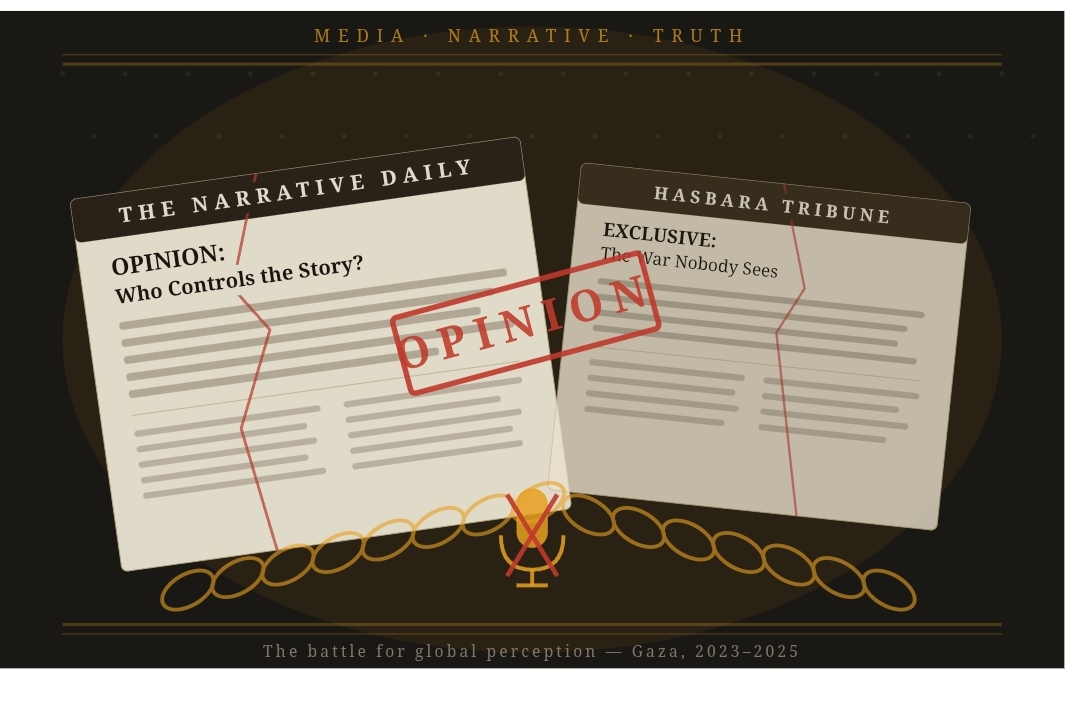
The Opinion Column as Weapon: Inside Israel's Media Strategy
How hasbara evolved from public diplomacy into a $730 million narrative infrastructure — and what it means for the global information landscape after October 7.
In the age of instant information, the opinion article has become one of the most powerful weapons in any state's media arsenal. Nowhere is this more visible than in the Israeli-Palestinian conflict — and particularly since October 7, 2023, when Israel launched what has become one of the most intensely documented and contested media wars in modern history.
This is an examination of why Israeli media, government-aligned outlets, and pro-Israel voices invest so heavily in opinion journalism, what goals these pieces serve, and how their messaging is amplified — or challenged — across the global information landscape. This is not a one-sided indictment. It is a critical, evidence-based analysis of a media strategy that has reshaped international discourse.
What is hasbara, and why does it matter?
To understand why Israeli media writes opinion pieces at the scale it does, you must first understand hasbara — a Hebrew word literally meaning "explaining." Officially defined as Israel's public diplomacy apparatus, hasbara has evolved far beyond simple explanation. It now functions as a sophisticated, state-funded narrative management system that spans traditional media, social platforms, and even artificial intelligence.
According to Israel's 2025 budget figures, the government planned to spend $150 million on hasbara — a 20-fold increase from previous years. By the 2026 budget, that figure expanded to NIS 2.35 billion, approximately $730 million. These are not the budgets of a passive communications office. They represent an aggressive, coordinated campaign to shape how the world thinks about Israel — and opinion journalism is one of its central tools.
How opinion articles serve hasbara's goals
- Frame Israeli military operations as acts of self-defense, even when civilian casualties dominate coverage elsewhere
- Delegitimize Palestinian casualty figures and the credibility of Palestinian sources
- Deflect international criticism by pivoting to Hamas's conduct and ideology
- Address sympathetic audiences in the United States, Europe, and beyond — where public opinion shapes policy
The IDF Spokesperson's Unit: controlling the narrative from the inside
A landmark investigation published by +972 Magazine in 2025 pulled back the curtain on the Israeli military's own media operation. The IDF Spokesperson's Unit, far from being a passive press office, functions as an active engine of narrative production.
The unit ran a covert campaign operating accounts designed to look like independent, US-based non-profit news organizations — when they were in fact run by the Israeli military.
The investigation revealed that the unit ran a covert "Fact Check" campaign from October 2023 to December 2024 — operating WhatsApp, YouTube, and Instagram accounts designed to appear as independent, US-based non-profit news organizations. The investigation described this as evidence of a systematic "organizational culture of deception."
Documented tactics
- Selective leaks to favored journalists, ensuring that certain stories were published by one outlet and not another
- Embedded access granted only to journalists who agreed to submit all materials and footage to IDF review before publication
- Exclusion of critical reporters — according to one correspondent quoted in the investigation, the chief of staff had met with the press corps only twice since the war began, avoiding journalists who might challenge the military's narrative
- Influencer recruitment to amplify coordinated messaging, including lifestyle bloggers who were flown to Gaza to film content intended to counter reports of famine
These strategies feed directly into the production of opinion content. When only one side has access, only one side gets quoted — and the resulting opinion pieces reflect a heavily filtered version of reality. The architecture of access becomes the architecture of the narrative itself.
.jpg)