The Ozempic Revolution Has Arrived — And It's Bigger Than Anyone Predicted
April 22, 2026
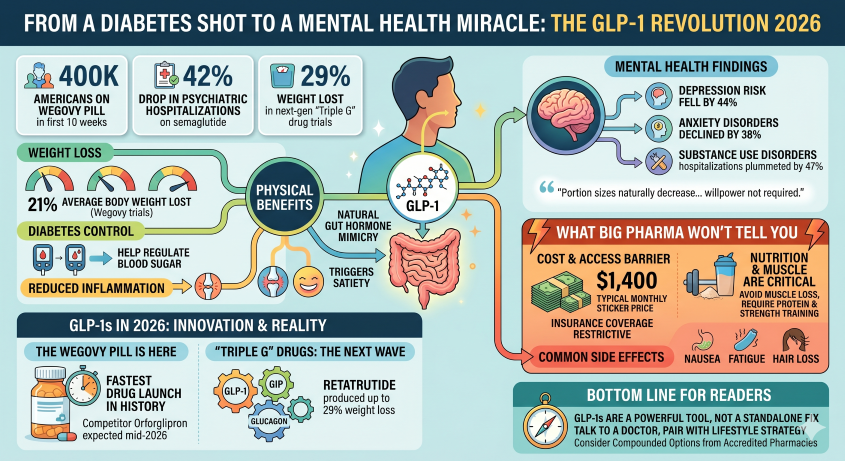
From a diabetes shot to a mental health miracle, GLP-1 drugs are rewriting the rules of medicine. Here's everything the science says in 2026 — and what Big Pharma won't tell you.
If you've typed "Ozempic," "Wegovy," or "GLP-1" into a search bar recently, you're not alone. These drugs have exploded into the American cultural consciousness, turning a once-obscure class of diabetes medications into the most talked-about pharmaceutical breakthrough in decades. And the latest research in 2026 suggests we've only scratched the surface of what they can do.
Americans are spending billions searching for answers: Does it work? Is it safe? Can I afford it? Is there a pill now? This article answers all of it — with the latest science, real numbers, and no hype.
What Exactly Is a GLP-1 Drug?
GLP-1 stands for glucagon-like peptide-1 — a hormone your gut naturally releases after you eat. It tells your brain you're full, slows digestion, and helps regulate blood sugar. Drugs like semaglutide (Ozempic, Wegovy, Rybelsus) and tirzepatide (Mounjaro, Zepbound) mimic or amplify this hormone's effects, creating a cascade of metabolic benefits that scientists are still discovering.
The mechanism is deceptively simple: your brain finally receives the satiety signals that, for millions of Americans with metabolic dysfunction, were chronically muted. The constant mental war with hunger quiets. Food becomes fuel rather than obsession. And the weight follows.
"The constant mental negotiation around food begins to quiet. Portion sizes naturally decrease. Weight begins to decline without the same willpower that traditional dieting once required."
The Bombshell 2026 Study Nobody Is Talking About Enough
Published in The Lancet Psychiatry in March 2026, a landmark Swedish study involving nearly 100,000 individuals revealed something that stunned the psychiatric community: semaglutide doesn't just shrink waistlines. It dramatically improves mental health.
The findings were extraordinary. People using GLP-1 medications saw psychiatric-related hospitalizations drop by 42%. Depression risk fell by 44%. Anxiety disorders declined by 38%. Hospitalizations for substance use disorders plummeted by 47%. Most strikingly, semaglutide was linked to reduced suicidal behavior.
"The reduction in sick leave was the most unexpected and significant result," said Professor Mark Taylor of Griffith University in Australia, one of the study's authors. "As mental health is now the most common reason people are absent from work due to ill health, this has major implications for public health."
While GLP-1's mental health benefits are exciting, researchers caution that the mechanism isn't fully understood. It could be the direct brain effects of the drug, or simply the cascade of lifestyle improvements — better sleep, less inflammation, more energy — that come with weight loss. More research is needed.
There's a Pill Now — And It Broke Records
For the millions of Americans who balked at weekly injections, 2026 brought a game-changer: the Wegovy pill. Approved by the FDA in December 2025, the oral version of semaglutide became — according to one Wall Street firm — the fastest drug launch in pharmaceutical history, reaching approximately 400,000 users in its first ten weeks.
The pill contains the same active ingredient as the injectable Wegovy and has shown similar effectiveness in clinical trials, producing roughly 15–17% body weight loss over 68 weeks. And a competitor is right behind it: Eli Lilly's oral GLP-1, called orforglipron, is expected to receive FDA approval by mid-2026.
The Next Generation: "Triple G" Drugs
Even as the current generation of GLP-1s dominates headlines, a next wave of weight-loss drugs is producing trial results that leave everything before them in the dust. Retatrutide — nicknamed "Triple G" because it mimics three hormones simultaneously (GLP-1, GIP, and glucagon) — produced average weight loss of up to 29% of body weight in clinical trials. That translates to roughly 71 pounds on average. The drug is also showing promising effects on knee pain, blood pressure, and inflammatory markers.
Novo Nordisk is pursuing similar ground, reporting nearly 20% weight loss after 24 weeks in mid-stage trials of another experimental compound.
The Uncomfortable Truth About Cost and Access
Here's where the dream collides with reality. The sticker prices for brand-name GLP-1s haven't fallen — they remain in the range of $1,000 to $1,400 per month for injectable versions. Insurance coverage has actually become more restrictive in 2026, with many plans requiring a BMI over 40 just to qualify for coverage, even though obesity is medically defined at BMI 30+.
The good news: competition is forcing prices down through indirect channels. Both Novo Nordisk and Eli Lilly began offering significant discounts directly to patients who bypass insurance. Compounding pharmacies — which offer semaglutide and tirzepatide at far lower prices — are still operating, though their regulatory future is uncertain now that the original drug shortages have been resolved.
What GLP-1 Drugs Cannot Replace
Here's the part the ads won't tell you. Because GLP-1 drugs suppress appetite dramatically, users often eat far less — sometimes dangerously less. Without careful nutritional planning, this can lead to muscle loss even as body weight drops. Protein intake can fall well below what the body needs to maintain lean mass. Some users also experience nausea, fatigue, and hair loss — the latter likely linked to rapid weight loss rather than the drug itself.
Doctors increasingly emphasize that GLP-1 medications are most effective when paired with structured strength training and nutrition support. The drug can quiet the hunger, but it cannot build muscle, protect joints, or create the metabolic adaptations that come from movement. The medications open a door — but you still have to walk through it.
GLP-1 drugs are the real deal — the science is extraordinary and 2026 is only deepening that picture. But they work best as a medical tool within a broader health strategy, not a standalone fix. Talk to a doctor, not just a telehealth chatbot, before starting. And if you can't afford brand-name options, compounded versions from PCAB- or NABP-accredited pharmacies remain an option worth discussing with your physician.
The Bottom Line
In 2026, GLP-1 drugs are no longer a niche pharmaceutical story. They are rewriting how America thinks about weight, metabolism, mental health, and even addiction. The pill form has eliminated one of the biggest barriers to access. The next generation of drugs will push efficacy beyond what seemed possible just five years ago.
But amid the revolution, the fundamentals of human physiology remain unchanged. Muscles still protect joints. Movement still supports longevity. Nutrition still fuels recovery. What's changed is that for the first time, millions of Americans now have a medical key that can unlock the door to health that felt permanently closed — and that is genuinely worth celebrating.
This article is for informational purposes only and does not constitute medical advice. Always consult a qualified healthcare professional before starting any medication.