IS AI ABOUT TO STEAL YOUR JOB — AND ARE TARIFFS MAKING IT WORSE?
April 22, 2026
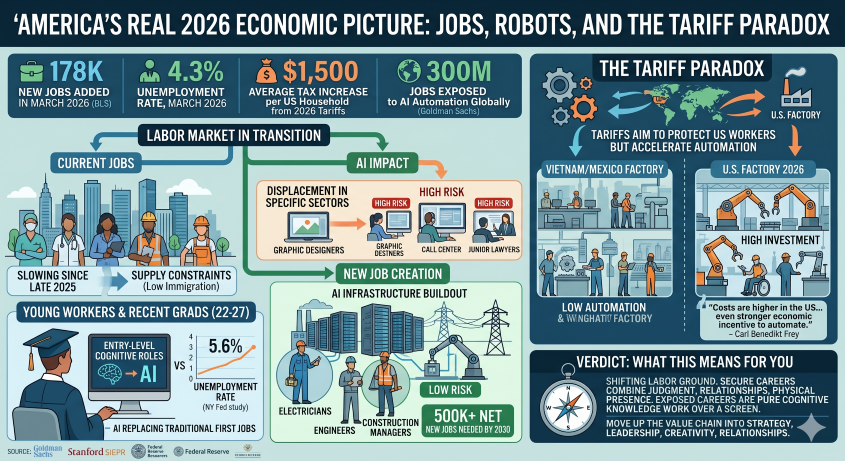
America was promised factory jobs. Instead, it may be getting robots. Here's the real 2026 economic picture — backed by Goldman Sachs, Stanford, and the Federal Reserve.
It's the economic question keeping Americans up at night, and driving millions of searches every week: Is artificial intelligence coming for my job? And with sweeping tariffs reshaping global trade, a secondary fear has layered on top: are the very policies meant to protect workers actually accelerating automation?
The answer, according to the best economists in the world in 2026, is: it's complicated — but the signals are real, and anyone who isn't paying attention is behind the curve.
The Jobs Are Still Here — For Now
The Bureau of Labor Statistics reported a surprisingly strong March 2026 jobs number: 178,000 new positions, with the private sector generating 186,000. The unemployment rate ticked down slightly to 4.3%. On the surface, this looks healthy. But economists urge caution about reading that headline in isolation.
The labor market has actually been slowing since the second half of 2025, driven by two seismic shocks: the uncertainty created by sweeping tariffs, which made employers hesitant to hire, and a dramatic deceleration in immigration. Together, these forces produced a labor market that's adding jobs slowly — not because demand for workers has crashed, but because supply constraints are holding the unemployment rate artificially stable.
"The big story in 2026 in labor will be AI. If we see some job losses pulled forward, that sets the stage for potential underperformance — and may lead the Federal Reserve to cut rates."
— JOSEPH BRIGGS, GOLDMAN SACHS RESEARCHWhat AI Is Actually Doing to Jobs Right Now
Goldman Sachs Research has been tracking the AI-labor nexus closely. Their findings in 2026 present a nuanced picture: AI's impact is real, but so far concentrated in specific sectors rather than economy-wide.
The clearest signal is in tech itself. The employment share of the technology sector — as a proportion of the whole economy — has fallen below its long-term trend. Companies that over-hired during the pandemic boom are now using AI to do more with fewer people. Management consultants, call center workers, and graphic designers have also seen displacement. These aren't layoffs announced with a press release — they're hiring freezes and quiet reductions that don't make the front page.
Goldman Sachs projects that in their base case — AI adoption spreading over roughly a decade — about 6–7% of workers will be displaced during the transition, producing a 0.6 percentage point rise in unemployment. But if adoption is frontloaded and faster than expected, the impacts balloon dramatically.
Job Category AI Risk Level Why Graphic Designers HIGH Generative AI handles visual creation at scale Call Center Reps HIGH AI agents handle tier-1 support autonomously Junior Lawyers / Paralegals HIGH AI outperforms in document review and research Recent College Graduates HIGH Entry-level cognitive work increasingly automated Construction Workers LOW Complex physical environments resist automation Electricians / Lineworkers LOW 500K+ new jobs needed for AI power grid by 2030 Healthcare Workers (hands-on) LOW Human touch remains irreplaceable in direct care Management Consultants MEDIUM AI handles analysis; humans handle relationship strategyThe Tariff Paradox Nobody Warned You About
Here's the economic plot twist of 2026: the tariffs designed to bring manufacturing jobs back to America may be doing the opposite — accelerating automation.
The logic, according to economists at Oxford and Stanford, is ruthless in its simplicity. When companies manufacture in Vietnam or Mexico, labor is cheap. There's no economic incentive to automate. But force those companies to produce in the United States — where labor is expensive — and the cost-benefit math changes entirely. Suddenly, the enormous upfront investment in robotics and AI-driven manufacturing lines makes financial sense.
"There's no reason whatsoever to believe this is going to bring back a lot of jobs. Costs are higher in the United States — that means there's an even stronger economic incentive to automate even more tasks."
— CARL BENEDIKT FREY, PROFESSOR OF AI & WORK, OXFORD UNIVERSITYStanford economist Erik Brynjolfsson put it even more bluntly: "When you throw sand in the gears of supply chains and global trade, we're all just going to be a little bit poorer." The primary effect of tariffs, he argues, is economic inefficiency — not job creation.
The Tax Foundation estimates 2026 Trump tariffs represent the largest US tax increase as a percent of GDP since 1993.
The average American household is paying an estimated $1,500 more in 2026 due to tariff costs — up from $1,000 in 2025.
The Supreme Court ruled 6–3 in February 2026 that the IEEPA does not authorize tariffs, forcing a restructuring of the tariff regime. The economic and legal fallout continues.
The AI Spending Boom That Nobody Is Talking About
While job fears dominate headlines, a parallel story is unfolding: AI is also creating enormous demand for entirely different kinds of workers. The AI buildout requires massive physical infrastructure — data centers, power substations, cooling systems, fiber networks. The Federal Reserve Bank of Minneapolis found that AI-related imports accounted for 23% of all US imports in 2025, up from 15% in 2023, representing 70%+ growth in two years.
That infrastructure requires electricians, engineers, construction managers, and skilled tradespeople. Goldman Sachs estimates that roughly 500,000 net new jobs will need to be filled just to satisfy the growing demand for power from AI systems by 2030. These are jobs that cannot be easily automated — they exist precisely because AI requires physical infrastructure to run.
What's Happening to Young Workers
Perhaps the most troubling signal in 2026 comes from a Federal Reserve Bank of New York study on recent college graduates aged 22–27. Their unemployment rate hit 5.6% at the end of 2025 — significantly higher than the overall 4.2–4.3% rate. These are exactly the workers who would typically enter law firms, research organizations, and tech companies in entry-level cognitive roles — and those are precisely the roles AI is currently best at replacing.
The irony is painful: the generation that grew up with the internet, is most comfortable with AI tools, and was promised that education was the ticket to a secure future, is finding the job market the most hostile for exactly their skills.
THE VERDICT: WHAT THIS MEANS FOR YOU
The economy is not collapsing. Jobs are being added. But the ground beneath the labor market is shifting, and the people who adapt fastest will win. The safest careers in 2026 combine judgment, relationships, and physical presence — things AI cannot replicate. The most exposed careers are pure cognitive knowledge work that can be delivered over a screen. If your job involves sitting at a computer and processing information, now is the time to move up the value chain — into strategy, leadership, creativity, and relationships. The machines are getting good. But they're not people yet.
Data sourced from Goldman Sachs Research, Stanford SIEPR, Bureau of Labor Statistics, Tax Foundation, Federal Reserve Bank of New York and Minneapolis, and Axios. April 2026.
TRENDING IN AMERICA · ECONOMICS & TECHNOLOGY DESK
Share this with someone whose career depends on understanding what's coming.
© 2026 · ALL RIGHTS RESERVED